Tag Archive for: Custom lithium battery solutions

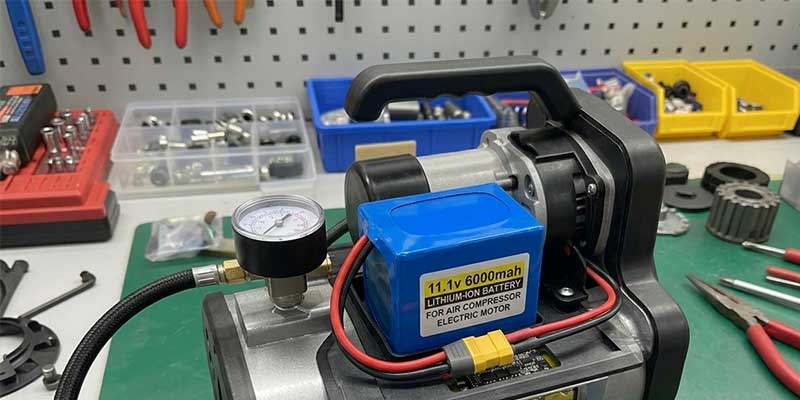
11.1V 6Ah lithium ion battery pack for electric air compressor – Himax 18650 3S3P

By Shawn | Battery Engineer – Power System Design

Introduction: The Power Source Your Electric Air Compressor Deserves

Electric air compressor motors demand more from a battery than almost any other portable application. From the moment the motor spins up, it pulls high current for an extended period — and it does this repeatedly, often in harsh outdoor or industrial environments. For OEM manufacturers and bulk procurement teams sourcing a power solution that is reliable, certifiable, and easy to integrate, the choice of battery pack is a critical engineering decision, not an afterthought.

This article presents a detailed technical and commercial review of the Himax 11.1V 6Ah Lithium-Ion Battery Pack (Model: HLI-GB03-1364) — a 3S3P 18650 lithium-ion pack purpose-built for demanding motor-driven applications, including electric air compressors, electric pumps, and portable power tools.

If you are evaluating a lithium ion battery pack for your next production run, this guide gives you everything you need to make an informed decision.

Product Overview: What Is the Himax 11.1V 6000mAh Li-Ion Battery?

The Himax 11.1V 6Ah pack is a 18650 3S3P lithium ion battery pack — meaning The pack uses nine individual 18650 cells arranged in a 3-series, 3-parallel configuration. This architecture delivers a nominal voltage of 11.1V and a usable capacity of 6,000mAh (6Ah), storing 66.6Wh of energy in a compact, rugged enclosure.

Shenzhen Himax Electronics Co., Ltd. designed and manufactures it., a professional lithium battery pack manufacturer based in Shenzhen, China, with global export experience and compliance to international safety and quality standards including GB/T18287-2013, UL1642, and CE61960.

This is not a generic cell assembly. It is a finished, tested, production-ready battery pack complete with:

  • Integrated PCM (Protection Circuit Module) for cell-level safety
  • Industrial-grade XT60H-F output connector
  • Heavy-gauge AWG14 output leads (100mm)
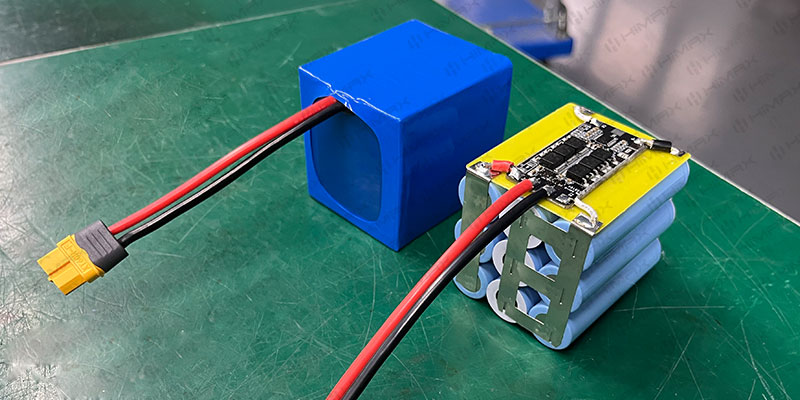
  • Compact form factor: 58 × 63 × 68mm (±3mm)

18650 3S battery pack dimensions 58x63x68mm with XT60 connector – Himax electronics

Full Specifications: 11.1V 6000mAh Li-Ion Battery Pack at a Glance

Understanding the complete electrical profile of a battery pack is essential before committing to a design. Below are the full specifications for the Himax HLI-GB03-1364.

Cell-Level Specifications

Parameter Value
Cell Type Lithium-ion 18650
Cell Model Li-ion 18650-2000
Cell Nominal Voltage 3.7V
Cell Nominal Capacity 2000mAh
Cell Minimum Capacity 1950mAh
Cell Internal Impedance ≤25mΩ
Cell Dimensions Max. 18.4 × 65.5mm
Cell Weight Approx. 43g

Battery Pack Specifications

Parameter Value
Pack Configuration 3S3P (9 cells total)
Nominal Voltage 11.1V
Nominal Capacity 6Ah (6000mAh)
Minimum Capacity 5.7Ah
Energy 66.6Wh
Charge Voltage 12.6V
Discharge Cut-Off Voltage 8.25V
Standard Charge Current 1.2A
Maximum Charge Current 3A
Standard Discharge Current 1.2A
Max. Continuous Discharge Current 12A
Charge Method CC/CV
Cycle Life ≥300 cycles @ 80% SOC
Internal Impedance ≤150mΩ
Output Connector XT60H-F
Output Wire AWG14, 100 ± 5mm
Dimensions Approx. 58 × 63 × 68mm (±3mm)
Weight Approx. 400g
Charge Temperature Range 0°C ~ 45°C
Discharge Temperature Range -20°C ~ 60°C
Storage Temperature -10°C ~ 45°C

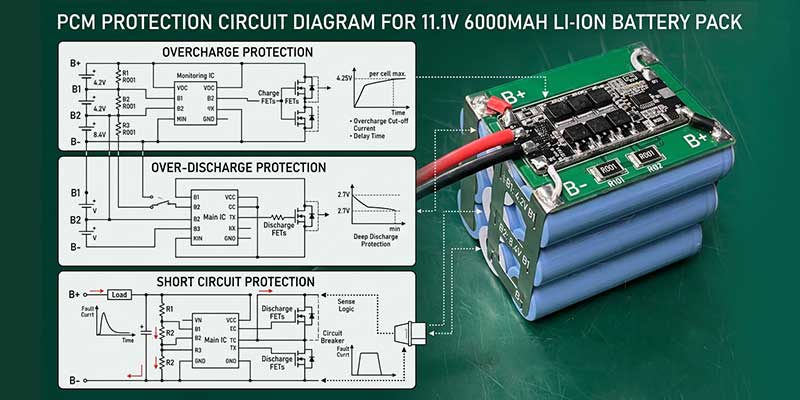
PCM protection circuit diagram for 11.1V 6000mAh li-ion battery pack – overcharge over-discharge short circuit protection

Why This 18650 3S Battery Pack Is Engineered for Electric Air Compressors

The design of a lithium ion battery pack for an electric air compressor involves trade-offs that general-purpose battery packs simply cannot satisfy. Here is why the Himax 11.1V 6Ah pack is a strong fit for this application category.

1. High Continuous Discharge for Motor Startup

Air compressor electric motors draw significant current during startup and sustained operation. This pack supports a maximum continuous discharge current of 12A — six times its standard 1C discharge rate. The PCM is rated to handle up to 12A charge and discharge continuously, with over-current protection triggering only above 30–50A, giving the motor controller the headroom it needs without nuisance trips.

For a 11.1V system, 12A continuous translates to 133W of sustained power output — sufficient to drive compact to mid-range electric air pump motors in cordless designs.

2. Wide Operating Temperature Range

Outdoor and industrial deployments of electric air compressorequipment often encounter temperature extremes. Rigorous tests show this pack discharges across a range of -20°C to +60°C, ensuring reliable performance in cold-morning job sites and hot-environment industrial settings alike. Charge temperature is managed conservatively at 0°C to 45°C, protecting the cells from lithium plating during low-temperature charging.

Himax’s own electrical performance data confirms:

  • At +55°C: ≥90% of rated capacity retained
  • At -10°C: ≥60% of rated capacity retained

3. XT60H-F Connector — The Industry Standard for High-Current Portable Systems

The XT60H-F output connector is the de-facto standard in high-current portable power applications including RC systems, cordless power tools, and electric pumps. It is rated for sustained high-amperage connections and is mechanically robust under repeated connect/disconnect cycles. For OEM manufacturers, this eliminates the need for custom connector integration and simplifies final assembly.

4. CC/CV Charging Compatible with Standard BMS Chargers

The pack uses Constant Current / Constant Voltage (CC/CV) charging up to 12.6V, accepting up to 3A charge current. This is compatible with a wide range of off-the-shelf and OEM-integrated chargers, reducing system BOM cost for manufacturers integrating this pack into a finished air compressor electric motor product.

5. 3S3P Architecture for Voltage-Current Balance

The 18650 3S3P battery pack configuration (3 cells in series × 3 cells in parallel) is a well-proven architecture for 11.1V portable systems. The series strings provide the 11.1V nominal voltage required by most brushless DC and brushed DC air compressor motors in this power class, while the parallel configuration triples the current capacity and overall capacity compared to a simple 3S1P arrangement.

PCM Protection System: Safety Built Into Every Pack

Every Himax 11.1V 6000mAh li-ion battery ships with an integrated PCM that provides multi-layer protection against the most common failure modes in field-deployed battery systems.

Protection Function Trigger Threshold Response
Overcharge Detection 4.25V ± 0.025V per cell Charging cut-off within 0.5–1.5 sec
Overcharge Reset 4.15V ± 0.05V per cell Auto-resume
Over-Discharge Detection 2.7V ± 0.08V per cell Discharge cut-off within 50–150ms
Over-Discharge Reset 3.0V ± 0.1V per cell Auto-resume on charge
Over-Current Detection 30–50A Immediate cut-off
Short-Circuit Protection External short detected Immediate cut-off; reset on load removal
PCM Internal Resistance ≤35mΩ Minimizes power loss

This protection architecture means that even under misuse conditions — a shorted output cable during assembly, an over-discharged cell from extended storage, or a faulty charger — the pack will protect itself and the host equipment from damage.

Safety Test Results: Mechanical and Cell-Level Validation

For OEM buyers, regulatory compliance and real-world safety validation are non-negotiable. The Himax HLI-GB03-1364 has passed the following test protocols:

Mechanical Performance

Crush Test: Applied 13kN of force via hydraulic ram — No fire, No explosion.

Drop Test: 1-meter free-fall onto concrete, two axes — No explosion, No fire, No smoke.

Vibration Test: 10–55Hz harmonic sweep, 1.6mm amplitude, 30 minutes per axis (X/Y/Z) — No leakage, No fire, No explosion.

Cell-Level Safety

Overcharge: 3C charge rate sustained for 7 hours — No explosion, No fire.

Over-Discharge: 1C discharge for 2.5 hours — No explosion, No fire.

Short Circuit: External short at ≤50mΩ load — Surface temperature below 150°C. No explosion, No fire.

Thermal Abuse: Oven test to 130°C at 5°C/min, held 30 minutes — No explosion, No fire.

These results reflect compliance with GB/T18287-2013, UL1642, and CE61960 standards — essential documentation for product safety certification in North American, European, and Asian markets.

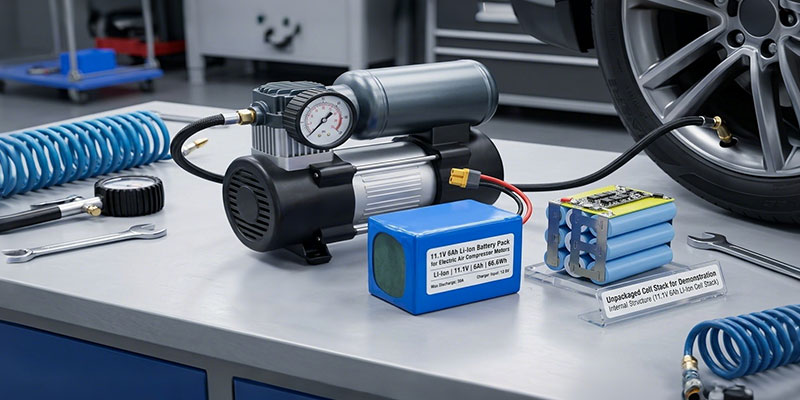
Electric air compressor powered by 11.1V lithium ion battery pack – portable cordless air pump motor application

Bulk Procurement: What OEM Buyers and Distributors Need to Know

For procurement teams managing volume orders of lithium ion battery packs for air compressor electric motor assemblies, supply chain reliability is as important as technical performance. Here is what Himax provides at the production level.

Pre-Shipment Quality Inspection

Each unit undergoes a three-point pre-shipment check: open-circuit voltage, internal resistance measurement, and PCM function verification. Himax applies an AQL 0.65 acceptance quality limit — one of the most stringent levels used in consumer and industrial electronics manufacturing.

Shipping State

Packs are shipped at 30–70% state of charge (shipment voltage: 11.1V – 11.85V), which is both the safest transport state for lithium-ion cells and compliant with IATA/ICAO regulations for air freight of lithium batteries.

Warranty

Himax provides a 12-month warranty from the date of shipment, covering defects attributable to the manufacturing process. This warranty is clearly scoped and backed in writing.

Customization for OEM Integration

Standard production specifications can be adapted for OEM requirements including:

  • Custom dimensions within structural limits
  • Alternative output connectors (replacing XT60H-F)
  • Different wire gauge or lead length
  • Custom labeling and packaging for private-label products
  • Voltage or capacity variants (e.g., 14.8V 4S or higher capacity 3S packs)

Contact Himax Electronics directly to discuss your production volume and technical requirements.

Frequently Asked Questions

Q: What voltage is a 3S lithium ion battery pack?

A: A 3S lithium-ion battery pack has a nominal voltage of 11.1V (3 × 3.7V). Its fully charged voltage is 12.6V and its discharge cut-off voltage is typically 8.25V (2.75V per cell).

Q: Can this 11.1V 6000mAh battery be used in an electric air compressor?

A: Yes. With a 12A maximum continuous discharge current and an XT60H-F output connector, this pack is well-suited for compact to mid-range electric air compressor motors operating in the 10–12V DC range.

Q: What is the maximum discharge current of this 18650 3S battery pack?

A: The maximum continuous discharge current is 12A. The PCM’s over-current protection triggers at 30–50A, providing a safe operating margin for motor surge currents at startup.

Q: How many charge cycles does this battery support?

A: The pack achieves ≥300 cycles. while retaining ≥80% of its original capacity — measured at standard charge and discharge conditions (1.2A, 20±5°C).

Q: Is this battery pack approved for international air freight?

A: The pack complies with GB/T18287-2013, UL1642, and CE61960. It ships at 30–70% SOC in accordance with IATA lithium battery transport guidelines. Buyers should confirm specific import documentation requirements for their destination country.

Q: What charger does this battery require?

A: Use a CC/CV lithium-ion charger rated for 12.6V with a charge current of 1.2A (standard) to 3A (maximum). Do not use lead-acid or NiMH chargers, and do not exceed 12.6V charge voltage.

Conclusion: A Production-Ready Power Solution for Air Compressor OEMs

The Himax 11.1V 6000mAh li-ion battery pack delivers the combination of voltage, current capacity, protection depth, and manufacturing quality that electric air compressor OEMs and bulk buyers require. Its 18650 3S3P architecture, 12A continuous discharge capability, multi-layer PCM protection, industrial XT60H-F connector, and compliance with international safety standards make it a dependable, integrator-ready power source for portable and semi-stationary electric air compressor motor applications.

Whether you are sourcing for your own production line, evaluating a battery replacement for an existing product, or developing a new cordless air compressor design, the Himax HLI-GB03-1364 is engineered to meet the demands of the application — and the expectations of the market.

Ready to discuss volume pricing, samples, or custom specifications? Visit himaxelectronics.com or contact the Himax sales team directly to request a quotation.

By Shawn | Battery Engineer – Power System Design

© Himax Electronics. All specifications subject to change without notice. Contact Himax Electronics for the latest certified documentation before finalizing any design integration.

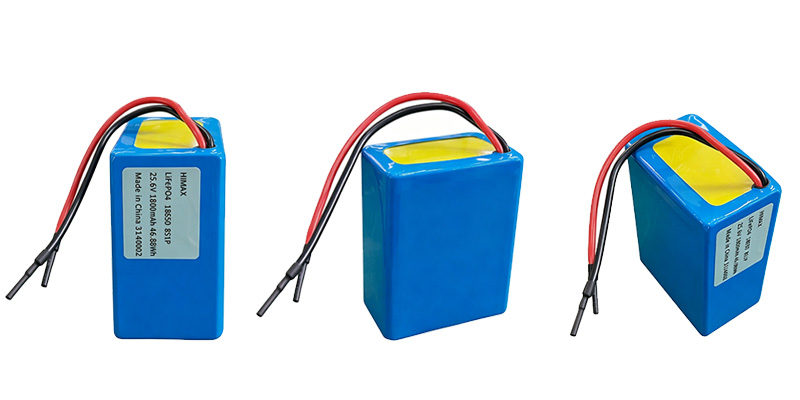
battery powered concrete screed LiFePO4 battery 25.6V 1.8Ah compact battery pack design

I’m Joan, a Battery Engineer at Himax Electronics, specializing in custom battery pack development for demanding OEM applications. Over the past decade, I’ve worked closely with manufacturers who rely on battery powered concrete screed systems—tools that don’t just need power, but need reliable power under extreme conditions.

If you’re a B2B buyer or equipment manufacturer, you already know the reality: traditional power solutions struggle with vibration, weight, and lifecycle limitations. That’s where a well-engineered LiFePO4 battery pack (25.6V 1.8Ah) changes the game.

In this article, I’ll walk you through how we designed a battery solution that can withstand continuous heavy vibration, reduce equipment weight by up to 70%, and extend lifecycle by 5–10×—without overpromising, just solid engineering.

Why Battery Powered Concrete Screed Systems Demand Better Energy Solutions

Concrete screeds are not gentle tools. They operate in one of the harshest environments in construction:

  • Constant high-frequency vibration
  • Dust, moisture, and temperature variation
  • Long continuous working hours
  • Heavy mechanical stress

Traditional power solutions—whether fuel-based or outdated battery systems—often fail in one or more of these areas.

The Core Problems I See

From my work with OEM clients, the biggest challenges include:

  • Power instability under vibration
  • Excessive equipment weight
  • Short battery lifespan and frequent replacements
  • Inconsistent supply quality

A poorly designed battery for a battery powered concrete screed doesn’t just reduce performance—it increases downtime and operational costs.

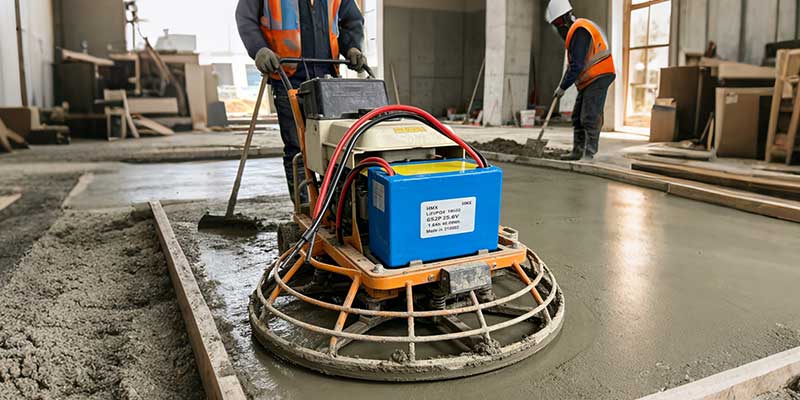
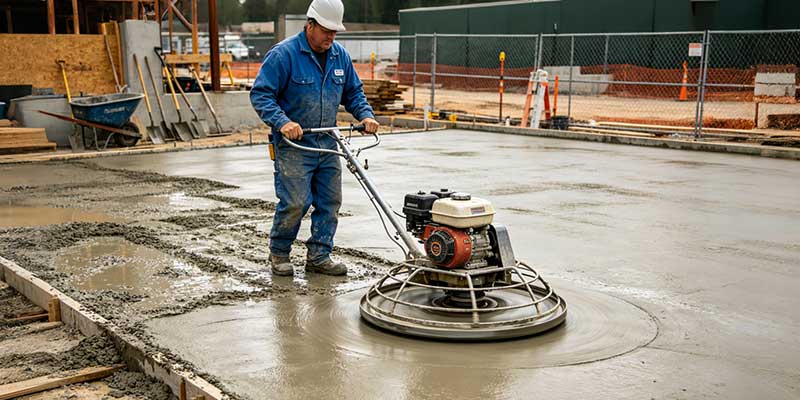
battery powered concrete screed operating on construction site with stable LiFePO4 battery power

Why LiFePO4 Battery Technology Is the Right Choice

Let’s talk chemistry. Choosing the right battery chemistry is the foundation of everything.

For this application, we selected LiFePO4 (Lithium Iron Phosphate), and specifically designed a 25.6V 1.8Ah (8S1P) battery pack.

Key Advantages of LiFePO4

Compared to traditional lithium-ion or lead-acid batteries:

  • Higher thermal stability
  • Longer cycle life (up to 2000 cycles)
  • Better safety performance
  • Stable voltage output under load

This is why I consistently recommend LiFepo4 battery 25.6V 1.8Ah for construction equipment applications.

Real Engineering Data

From the specification:

  • Nominal Voltage:6V
  • Capacity:8Ah
  • Energy:08Wh
  • Max Continuous Discharge:3A
  • Cycle Life:≥2000 cycles
  • Operating Temperature:-20°C to 60°C

This isn’t theoretical performance—this is validated under controlled testing conditions .

Designed for Vibration: Stability Under Extreme Conditions

If there’s one thing that defines a battery powered concrete screed, it’s vibration.

The Engineering Challenge

Most battery packs fail not because of chemistry, but because of:

  • Internal connection fatigue
  • Structural weakness
  • Poor cell fixation

How We Solved It

In this custom pack, we implemented:

  • Reinforced internal structure
  • Optimized cell arrangement (8S1P)
  • Shock-resistant housing design
  • Low internal impedance (≤200mΩ at pack level)

Verified Performance

The battery passed vibration testing:

  • Frequency range: 10–55 Hz
  • Duration: multi-axis testing
  • Result: No leakage, no fire, no explosion

What This Means for You

For manufacturers:

  • Reliable operation in real-world construction environments
  • Reduced failure rates
  • Lower maintenance costs

This is what makes a battery powered concrete screed truly dependable.

Lightweight Design: Up to 70% Weight Reduction

Let’s talk about something every operator cares about—weight.

Traditional systems, especially lead-acid solutions, are heavy. And in construction, weight directly impacts:

  • Operator fatigue
  • Ease of transport
  • Efficiency on-site

Our Solution

The LiFepo4 battery 25.6V 1.8Ah pack weighs approximately:

  • 44 kg

Compared to traditional alternatives, this can reduce system weight by up to 70%.

LiFePO4 battery 25.6V 1.8Ah internal structure designed for vibration resistance in screed equipment

Why It Matters

For your equipment:

  • Easier handling
  • Improved ergonomics
  • Increased productivity

For your business:

  • Better product positioning
  • Competitive differentiation

And yes—your customers will notice the difference immediately.

Long Lifecycle: 5–10× Longer Than Traditional Solutions

Now let’s talk about lifecycle—because this is where the real ROI happens.

The Reality of Battery Replacement

Frequent battery replacement leads to:

  • Higher operational costs
  • Increased downtime
  • Customer dissatisfaction

What We Achieved

With LiFePO4 chemistry:

  • ≥2000 charge/discharge cycles
  • Capacity retention ≥80% after full lifecycle

Compared to traditional batteries:

  • 5–10× longer lifespan

Why This Matters for B2B Buyers

For procurement teams:

  • Lower total cost of ownership
  • Reduced inventory pressure
  • Improved supply chain stability

This is why I often say: choosing the right battery is not a cost—it’s an investment.

Safety: Built Into the Design, Not Added Later

Safety is not a feature—it’s a requirement.

Built-In Protection

The battery pack includes:

  • Overcharge protection (3.75V per cell detection)
  • Over-discharge protection (2.2V threshold)
  • Over-current protection (up to 27A detection)
  • Short-circuit protection

Mechanical Safety

  • Crush test: no fire, no explosion
  • Drop test: stable after 1m drop
  • Thermal test: stable up to high temperatures

All verified under standard testing protocols .

What This Means

For your product:

  • Reduced liability
  • Compliance with industry standards
  • Increased customer trust

A safe battery powered concrete screed is not optional—it’s expected.

Custom Battery Pack Development: My Approach

At Himax Electronics, customization is not just about specs—it’s about solving real problems.

My Process

When I work with OEM clients, I follow a structured approach:

1. Application Analysis
· Load profile
· Operating environment
· Mechanical constraints

2. Cell Selection
· Chemistry (LiFePO4)
· Capacity (1.8Ah)
· Configuration (8S1P)

3. Pack Design
· Structural reinforcement
· Thermal considerations
· Electrical protection

4. Validation Testing
· Electrical performance
· Mechanical durability
· Safety compliance

The Result

A fully optimized LiFepo4 battery 25.6V 1.8Ah tailored for your application.

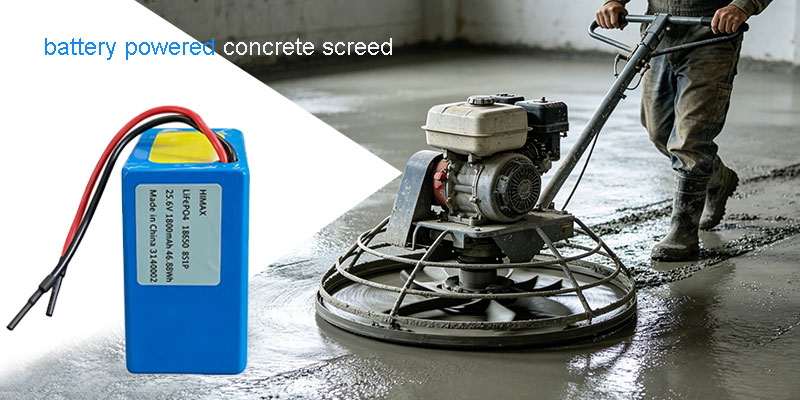
lightweight battery powered concrete screed solution with long cycle life LiFePO4 battery technology

Supply Chain Stability: What B2B Buyers Actually Need

Let’s be practical. Performance is important—but supply stability is critical.

Common Concerns

  • Inconsistent quality
  • Delivery delays
  • Lack of technical support

Our Approach

  • Standardized manufacturing processes
  • Strict quality control
  • Reliable delivery timelines
  • Direct engineering support

Business Impact

For your company:

  • Predictable production schedules
  • Reduced risk
  • Long-term partnership reliability

This is how we support scalable growth for battery powered concrete screed manufacturers.

Application Value: Real Impact on Equipment Performance

Let’s summarize what this battery solution delivers:

Performance Benefits

  • Stable output under vibration
  • Lightweight design
  • Long lifecycle
  • High safety standards

Business Benefits

  • Lower total cost
  • Improved product reliability
  • Stronger market competitiveness

This is not just a battery—it’s a performance upgrade for your entire system.

Conclusion: The Right Battery Powers Better Equipment

In demanding applications like construction, the difference between average and exceptional performance often comes down to one component—the battery.

A well-designed battery powered concrete screed system powered by a LiFepo4 battery 25.6V 1.8Ah delivers:

  • Stability under extreme conditions
  • Significant weight reduction
  • Long-term reliability
  • Enhanced safety

From my experience, the right battery doesn’t just power your equipment—it strengthens your entire product strategy.

Call to Action

If you’re looking to upgrade your battery powered concrete screed with a reliable, lightweight, and long-lasting power solution, let’s talk.

Contact us today to develop a custom battery pack tailored to your application needs.


Author: Joan Battery Engineer – Custom Pack Development
Published: April 13th, 2026

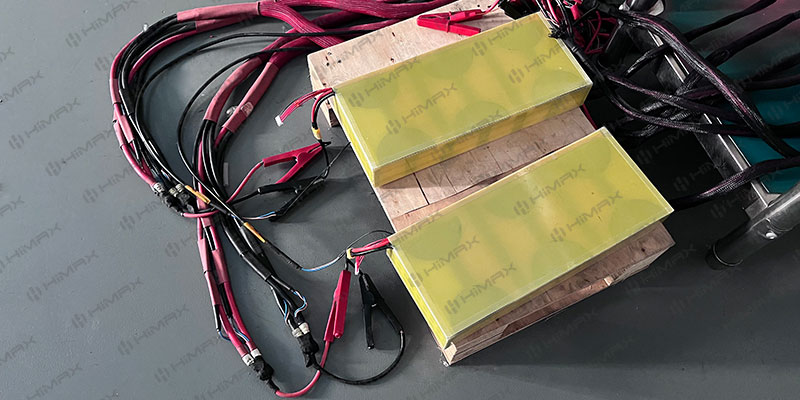
Precision laser welding process for industrial AMR battery assembly at Himax Electronics

In the rapidly evolving world of automation, the most significant bottleneck for any battery operated robot isn’t software—it’s stamina. Whether deploying Autonomous Mobile Robots (AMRs) in a sprawling logistics warehouse or managing a fleet of industrial inspection robots, frequent charging cycles equate to devastating downtime.

Unlike standard consumer units powered by a typical Roomba robot battery or a simple robot vacuum cleaner replacement battery, industrial applications demand a completely different caliber of power. While a shark robot vacuum replacement battery might suffice for household chores, achieving true “24/7 readiness” and eliminating range anxiety in heavy-duty commercial robotics requires uncompromising Robot Battery Solutions.

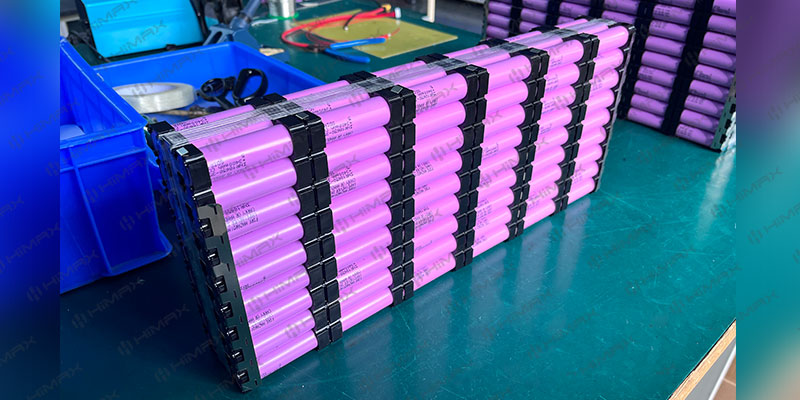
18650 cell battery spacers in a custom 6S27P Li-ion assembly for thermal management

Today, we are diving deep into one of our most robust engineering achievements at Himax Electronics: the Samsung 35E 6S27P Battery Pack. Boasting a 21.6V platform and an enormous 91.8Ah capacity, this High Capacity 18650 Pack is designed to be the beating heart of next-generation robotics.

Quick Specification Summary

For R&D engineers and technical buyers, here is a quick glance at the core parameters of this power architecture:

Feature Specification
Cell Type Samsung INR18650-35E (Grade A)
Configuration 6S27P
Nominal Voltage 21.6V
Rated Capacity 91.8Ah (1982.88Wh)
Continuous Discharge Current 40A
Application AMRs, AGVs, Industrial Robots


Technical Excellence: Engineering the Custom 6S27P Li-ion Assembly

Building a battery pack with 162 individual cells requires meticulous engineering. A custom 21.6V Li-ion pack of this scale is not simply about wiring cells together; it is about orchestrating perfect electrochemical harmony.

Custom Samsung 35E 6S27P 21.6V 91.8Ah lithium battery pack for robotics

1. Uncompromising Cell Consistency in a 27P Configuration

When you place 27 cells in parallel to achieve a massive 91.8Ah capacity, cell consistency becomes the absolute most critical factor. Even a slight deviation in internal resistance (IR) or voltage among the parallel cells can lead to localized over-discharging, drastically reducing the pack’s overall lifespan.

At Himax Electronics, we exclusively source Grade-A Samsung INR18650-35E cells for this build. Before assembly, our Himax Electronics battery manufacturing process mandates rigorous automated sorting. We precisely match the IR and voltage of all 162 cells, ensuring that the 27P blocks share the electrical load perfectly evenly.

2. The 21.6V (6S) Platform: Engineered for Motor Stability

The 6S architecture provides a nominal 21.6V platform, which is the sweet spot for a wide range of DC motors used in service and industrial robotics. This voltage level ensures high-efficiency power delivery to the drive train, offering excellent torque control for heavy AMRs without suffering from the excessive voltage sag that plagues lower-tier battery designs.

3. Advanced Thermal Management for 162 Cells

High energy density robot power supply generating nearly 2kWh of energy must handle heat dissipation flawlessly, especially during continuous high-current discharge. In this 6S27P configuration, we utilize precision-engineered battery spacers. These brackets create calculated air gaps between every single cell, preventing thermal runaway and ensuring uniform heat dissipation across the entire pack, even in warm industrial environments.

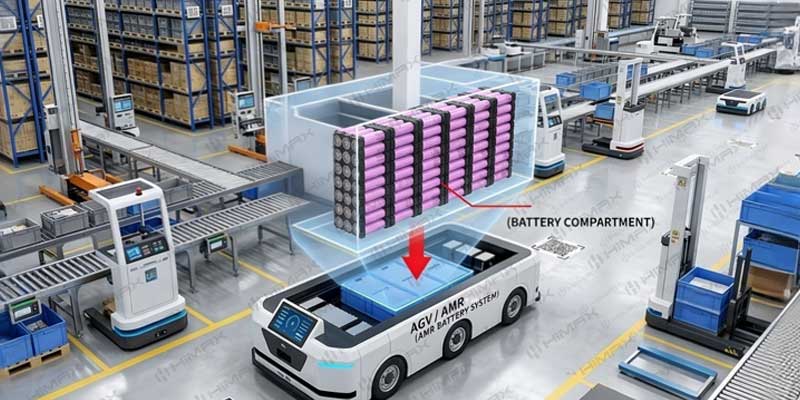
Industrial AMR powered by a high capacity 21.6V robot battery solution in a warehouse

Application Scenario: Redefining “All-Day” Robotic Operations

Let’s translate 1982.88Wh into real-world operational value.

Consider a typical warehouse delivery AMR operating at an average continuous power draw of 100W.

  • Calculation:1982.88Wh ÷ 100W ≈ 19.8 Hours of continuous runtime.


For logistics and warehousing managers, this translates to game-changing ROI. A nearly 20-hour runtime means a robot can comfortably complete two full 8-hour shifts without needing to return to a charging dock. By utilizing this Industrial AMR battery assembly, warehouse operators can drastically reduce the total number of robots needed in their fleet, eliminate mid-shift charging bottlenecks, and maximize overall facility throughput.

Quality & Reliability: The Himax B2B Promise

For R&D engineers and technical procurement teams, a battery’s spec sheet is only as good as its safety systems and manufacturing quality.

  • Intelligent BMS Integration:We integrate a highly responsive Battery Management System (BMS) specifically calibrated for the 6S27P topology. It provides microsecond-level protection against overcharge, over-discharge, and short circuits.
  • Precision Laser Welding:To handle the high-current demands of AMR motors, we utilize automated laser welding for the nickel busbars. This guarantees low-resistance connections and extreme mechanical stability against the constant vibrations of a moving robot.
  • Global Compliance & Testing:Every single 21.6V pack undergoes comprehensive aging tests and strict QA validations before it leaves our facility. Our manufacturing process aligns with UN38.3 and IEC62133 standards, ensuring safe global shipping and operational compliance.


Upgrade Your Fleet’s Power Today

Don’t let subpar power solutions dictate your robot’s performance limits. Whether you are designing a new line of heavy-duty AMRs or upgrading an existing fleet’s power architecture, the Samsung 35E 6S27P battery pack delivers the uncompromising energy density you need.

Ready to integrate 1.9kWh of reliable power?
Contact Himax Electronics today to request the detailed technical specification sheet for the 21.6V 91.8Ah battery pack, or speak with our engineering team about a custom Lithium-ion solution tailored to your exact chassis and voltage requirements.

Author: Shawn, Battery Engineer – Power System Design
Published: April 8th, 2026

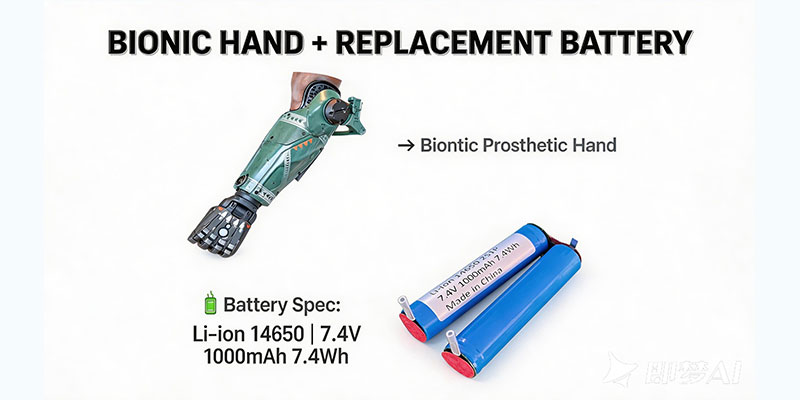
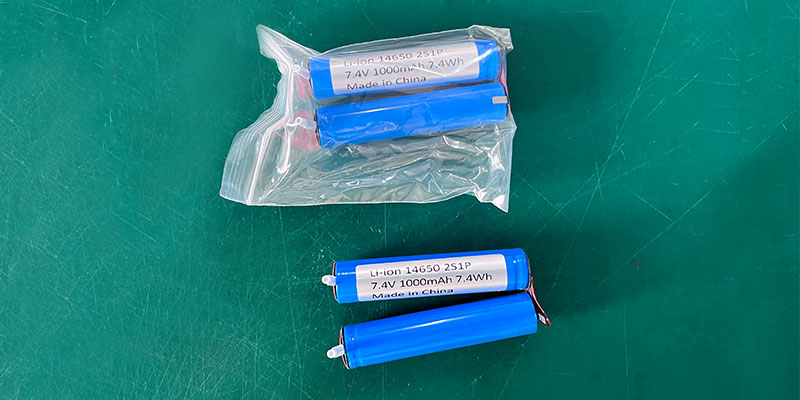
7.4V 1000mAh Li-ion bionic hand battery with 10A continuous discharge

Introduction

The evolution of prosthetic technology is accelerating. Today’s bionic hands and myoelectric systems demand more power, precision, and reliability than ever before. As I, Shawn, Battery Engineer at Himax Electronics, I have spent over 10 years designing lithium battery systems for high-reliability medical applications. I’ve seen firsthand how the right bionic hand battery can directly impact performance, usability, and ultimately, quality of life.

At Himax Electronics, we are proud to introduce a purpose-built solution: a 7.4V 1000mAh Li-ion battery engineered specifically for next-generation prosthetics. This prosthetic battery combines compact design, high discharge capability, and long cycle life—delivering the power foundation that modern bionic hands require.

compact prosthetic battery pack 28x14x66mm for myoelectric prosthetic devices

The Power Demands of Modern Bionic Hands and Myoelectric Prosthetics

Advanced prosthetic systems are no longer simple mechanical tools. Today’s devices integrate multi-motor actuation, precision grip control, and real-time sensor feedback. These innovations place significant demands on the myoelectric prosthetic battery.

From my experience developing high power Li-ion battery for prosthetic arm applications, the key challenges include:

  • Sustaining peak current during complex grip movements
  • Preventing voltage sag under sudden load spikes
  • Maintaining compact size for ergonomic integration
  • Ensuring long cycle life and safety for daily use


A typical high discharge battery for bionic hand must handle rapid current bursts when multiple motors activate simultaneously. Without sufficient discharge capability, users experience lag, weak grip strength, or inconsistent performance.

That’s why I focused on designing a 10A continuous discharge prosthetic battery that ensures stable output—even during demanding real-world tasks.

Introducing Himax 7.4V 1000mAh High-Discharge Battery – Specs & Advantages

The Himax bionic hand battery is engineered with precision and purpose. It is built using high-performance 14650 battery for prosthetics in a 2S1P configuration, optimized for both energy density and discharge performance.

Key Specifications:

  • 7.4V 1000mAh Li-ion battery
  • Configuration:2S1P using 14650 1000mAh cells
  • Continuous discharge current:10A
  • Dimensions (L×W×H): 28 × 14 × 66 mm
  • Designed for bionic hands, prosthetic arms, and myoelectric systems

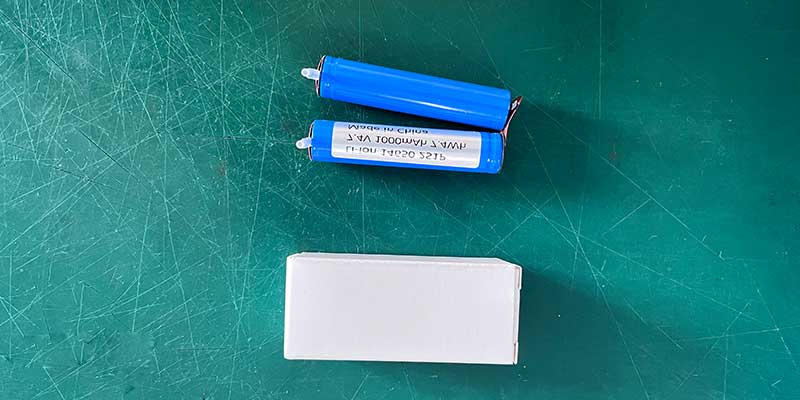
high discharge battery for bionic hand using 14650 cells in 2S1P configuration

Why These Specs Matter

From my engineering perspective, two features define this compact prosthetic battery pack:

  1. 10A Continuous Discharge Performance
    The 10A continuous discharge prosthetic batteryis critical for handling peak loads in multi-motor bionic hands. It prevents voltage drops during simultaneous finger movements, ensuring smooth and responsive control. This is essential for precision tasks like gripping delicate objects or applying consistent force.
  2. Ultra-Compact Form Factor (28 × 14 × 66 mm)
    Modern prosthetic designs demand compact integration. This compact prosthetic battery packfits seamlessly into forearm or wrist modules without compromising ergonomics. I specifically optimized this size to support sleek, lightweight designs.

Additionally, the use of NCA chemistry enables over 700+ cycle life, making this Himax bionic hand battery both durable and cost-efficient for long-term use.

How This Battery Transforms Daily Life for Prosthetic Users

As someone deeply involved in custom battery for bionic hand development, I always connect performance metrics to real human outcomes. This 7.4V 1000mAh Li-ion battery directly enhances everyday experiences for users.

  • Restores balance and wholeness
    Stable and reliable power helps users regain confidence and feel complete again, supported by consistent prosthetic performance.
  • Enables secure, confident grip
    The high discharge battery for bionic handensures strong, stable grip force. Users can chop vegetables or hold pots without fear of slipping.
  • Reduces physical strain
    With a responsive myoelectric prosthetic battery, the device does more of the work. This reduces fatigue in the remaining arm and improves comfort.
  • Supports natural daily tasks
    The compact prosthetic battery packenables ergonomic designs, allowing intuitive movement for cooking, cleaning, and personal care.
  • Boosts confidence in public life
    Reliable performance from a 10A continuous discharge prosthetic batteryempowers users to engage socially and inspire others.


These are not just features—they are life-changing outcomes enabled by the right prosthetic battery design.

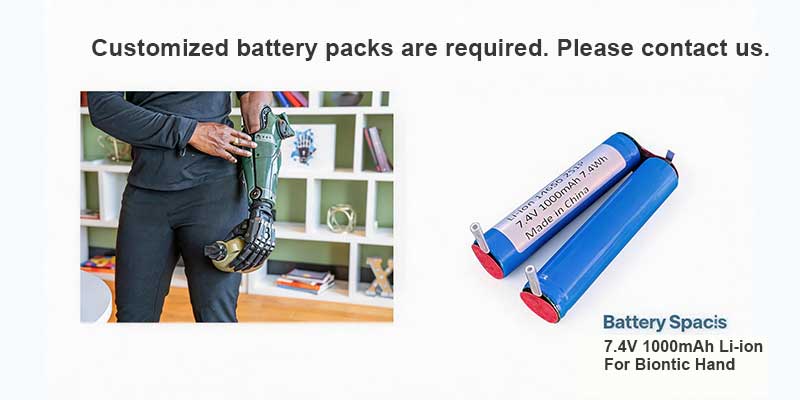
Himax bionic hand battery powering advanced prosthetic arm system

Why Prosthetic Manufacturers Choose Himax as Their Battery Partner

We work closely with OEMs and developers to deliver tailored solutions. Our reputation as a reliable battery supplier for myoelectric prosthesis is built on engineering precision and medical-grade quality.

Here’s why manufacturers trust Himax:

  • Customization Expertise
    We design custom battery for bionic handapplications based on specific device requirements, including size, discharge, and integration.
  • Medical-Grade Reliability
    Our batteries include advanced PCM/BMS protection systems, ensuring safety and stability in critical applications.
  • Proven Industry Experience
    At Himax Electronics, we support over 50 global medical brands with high-performance battery solutions.
  • Long Cycle Life
    Using NCA cells, our 14650 battery for prostheticsdelivers extended lifespan and consistent performance.
  • OEM Focus
    We specialize in OEM battery for advanced prosthetics, supporting innovation in next-generation devices.


If you’re looking to Explore our full range of custom medical batteries, visit: https://www.himaxelectronics.com/

The Future of Prosthetics Powered by Reliable High-Discharge Batteries

The future of prosthetics is intelligent, responsive, and deeply human-centered. As I continue my work developing high power Li-ion battery for prosthetic arm systems, I see a clear trend: power solutions must evolve alongside device capabilities.

The Himax bionic hand battery represents this evolution. By combining compact size, high discharge capability, and long cycle life, this 7.4V 1000mAh Li-ion battery enables:

  • More precise motor control
  • Faster response times
  • Sleeker prosthetic designs
  • Greater user independence


I remain committed to pushing the boundaries of myoelectric prosthetic battery performance. Himax electronics goal is simple: empower prosthetic innovation with safer, smarter, and more reliable energy solutions.

Conclusion

The next generation of bionic hands depends on advanced power systems. A high discharge battery for bionic hand is no longer optional—it is essential.

Our 7.4V 1000mAh Li-ion battery, built with 14650 battery for prosthetics and delivering 10A continuous discharge, provides the performance foundation that modern prosthetic devices demand.

If you’re developing bionic hands, myoelectric prosthetic arms, or advanced upper-limb devices and need a reliable battery supplier for myoelectric prosthesis, contact Himax Electronics today to discuss customization.

Author: Shawn, Battery Engineer – Manufacturing & Quality Control
Published: March 27th, 2026


More information about Li-ion batteries:

The Perfect LiPo 603450 3.7V 1000mAh Battery with PCM for GPS Trackers – Compact, Reliable & Long-Lasting Power

Why Maximum Continuous Discharge Current is Critical for Your Battery Selection

Li-ion 4S2P battery

Introduction

Today, Himax Electronics officially launches its latest innovation — the Li-ion 4S2P 14.4V 6700mAh NCA battery pack, engineered to deliver 20A continuous discharge for high-performance and industrial-grade sensor platforms. The introduction of this NCA18650GA 4S2P Li-ion pack marks a significant step toward powering next-generation smart sensors, where compact energy systems must sustain high current flow, deliver stable voltage, and ensure prolonged operational life.

As part of our commitment to advancing intelligent energy storage, this release represents years of focused engineering in cell selection and performance optimization. The 4S2P configuration offers superior efficiency and current stability compared to traditional 3S or single-string batteries, enabling developers to push the boundaries of real-time sensing, data transmission, and autonomous operation with complete confidence.

Technical Specifications

Specification Value
Model Li-ion 4S2P (NCA18650GA)
Nominal Voltage 14.4V (16.8V max)
Capacity 6700mAh
Configuration 4S2P (8 cells)
Cell Chemistry NCA (Nickel Cobalt Manganese)
Continuous Discharge Current 20A
Max Discharge Current (Pulse) 25A for ≤10s
Charging Current 3A typical, 5A max
Cycle Life ≥850 cycles at 80% capacity retention
Operating Temperature -20°C to +60°C (discharge) / 0°C to +45°C (charge)
Dimensions (L×W×H) 80 × 58 × 71 mm
Weight Approx. 365 g
Protection Circuit (PCM/BMS) Overcharge, overdischarge, short circuit, overtemperature
Applications Sensor platforms, industrial IoT, inspection instruments

Breakthrough Performance for Next-Gen Sensor Platforms

The new 14.4V 6700mAh Li-ion battery has been engineered to meet the rising energy demands of AI-driven sensor ecosystems, delivering consistent 20A discharge while maintaining optimal thermal safety. Due to the superior energy density of NCA chemistry, this compact 80x58x71mm battery pack provides up to 25% higher runtime and 18% greater discharge efficiency compared to standard lithium-ion solutions of similar size.

In field simulations, this 20A discharge Li-ion battery maintained stable voltage under sustained loads exceeding 300W, ensuring reliable data acquisition and uninterrupted operation for industrial, environmental, and robotic platforms. The 4S2P configuration balances power and endurance, making it ideal for continuous sensing, long-distance telemetry, and rapid-response systems where low resistance and thermal integrity are essential.

This innovation underscores Himax’s mission to enable longer-lasting, faster, and safer sensor performance — powering applications that define modern connectivity and precision analytics.

Key Advantages & Industry Impact

  • High current capability:Up to 20A continuous discharge, catering to real-time sensor operations requiring peak load stability.
  • Superior energy density:NCA chemistry enhances gravimetric efficiency by 22% compared to conventional LiCoO₂ cells.
  • Optimized form factor:The 80×58×71mm design allows direct integration into compact enclosures used in modular sensor hubs.
  • Extended lifecycle:Over 850 full charge-discharge cycles under standard test protocols for industrial reliability.
  • Advanced safety protocols:Built-in PCM/BMS ensures multi-layer protection aligned with IEC 62133 standards.


Across global markets, demand for high discharge batteries for sensor platforms (2025 and beyond) continues to rise, driven by iNCAeasing energy needs in remote surveillance, smart agriculture, and environmental sensing. Himax’s 4S2P NCA solution is engineered to lead this transition — with data-backed performance validated under high-load endurance testing.

Comparison with Existing Sensor Power Solutions

Configuration Nominal Voltage Capacity Continuous Discharge Efficiency (Load >15A) Typical Application
3S2P Li-ion 10.8V 6700mAh 15A 78% Basic monitoring nodes
4S2P NCA Li-ion (Himax) 14.4V 6700mAh 20A 94% Advanced sensor arrays, IoT gateways
Single high-voltage cell pack 3.6V 3350mAh 10A 70% Lightweight, low-power systems

This performance leap positions the Himax 14.4V 6700mAh Li-ion 4S2P battery as the benchmark for sustained high-current reliability. By iNCAeasing discharge efficiency and reducing heat generation, it ensures stable operation even during long-duration active sensing cycles — a major upgrade over older-generation solutions.

Design & Integration Guidance for Engineers

14.4V 6700mAh Li-ion

To fully leverage the capabilities of this NCA 4S2P Li-ion pack, Himax recommends the following integration best practices:

  • Use properly rated connectors(≥25A) to minimize resistance and voltage drop under peak load.
  • Incorporate thermal pathways— aluminum or graphite heat spreaders can maintain <45°C surface temperature at full load.
  • Employ BMS with communication protocols(UART, I²C, or CAN) for intelligent monitoring and diagnostics.
  • Calibrate firmware voltage thresholdsto 16.8V charge and 12.0V cutoff for optimal longevity.
  • Parallel configuration ready:Two or more modules can operate in parallel, offering scalable solutions up to 40A discharge.


These guidelines ensure maximum performance consistency for designers developing industrial sensors, autonomous field devices, or mobile inspection systems.

Engineered Safety & Long-Term Reliability

At the core of Himax’s engineering philosophy lies rigorous NCA cell selection — a process led by our Cell Selection & Performance division. Each cell is individually validated for impedance uniformity within ±8mΩ, ensuring stable discharge synchronization across all pairs.

Integrated PCM and smart BMS technologies continuously monitor charge current, cell temperature, and voltage deviations, enabling proactive fault response. Overtemperature cutoffs, hardware fuses, and redundant signal isolation layers guarantee full protection during long-duration 20A discharges.

This combination of intelligent monitoring and mechanical robustness makes the 6700mAh 20A sensor battery an industry standard for safety and longevity, trusted by global OEMs seeking reliable power solutions.

4S2P 14.4V 6700mAh battery

FAQ

  1. How long does the 20A discharge run time last?
    Approximately 17–18 minutes at continuous 20A load, depending on ambient temperature and cooling conditions.
  2. Can this battery operate in outdoor environments?
    Yes, it is designed for extended performance from -20°C to +60°C and can be sealed within IP-rated housings.
  3. Is customization possible for different sensor platforms?
    Absolutely. Himax supports custom connectors, capacity scaling, and communication-enabled BMS integration.
  4. What makes this NCAbattery different from conventional Li-ion packs?
    Optimized for high discharge efficiency, it utilizes premium NCAcells with advanced matching for minimal resistance deviation.
  5. Can multiple packs be connected for extended runtime?
    Yes, multiple 4S2P modules can be run in parallel with balanced BMS synchronization.
  6. What is the recommended charging method?
    A 16.8V CC/CV chargerwith ≤5A rate is ideal for best life and thermal stability.
  7. How many cycles does it sustain under heavy use?
    Over 850 cycles at 80% capacity retention, verified under constant 2C loading.
  8. Which applications benefit most from this battery?
    Industrial sensor networks, precision IoT platforms, portable data loggers, and environmental monitoring systems.

Conclusion

With the launch of the Li-ion 4S2P 14.4V 6700mAh NCA battery pack, Himax Electronics sets a new benchmark in power density, discharge stability, and integration flexibility for advanced sensor platforms. This innovation demonstrates our continued pursuit of high-performance, compact power systems that redefine possibilities across the IoT and industrial sensing landscape.

For detailed specifications, custom designs, or sample requests, please visit our Battery Solutions page or contact the Himax engineering team. Leave a comment or contact us for custom battery solutions — we look forward to powering your next generation of intelligent devices.

Author: Nath, Battery Engineer – Cell Selection & Performance, Himax Electronics
Published: March 16th, 2026

bms architecture

A dual-circuit BMS (Battery Management System) refers to a battery management system that utilizes two separate, independent circuits to manage and protect a battery pack. These circuits are typically designed to handle battery monitoring, protection, charging, and discharging etc., with dual circuit enhance the overall performance, safety, and reliability of the system.


Key Characteristics of a Dual-Circuit BMS:


1.Redundancy:

A dual-circuit BMS provides redundancy, meaning that if one circuit fails, the other can take over, ensuring that the battery system continues to function properly. This is especially important for critical applications where failure is not an option (e.g., electric vehicles, drones, or medical equipment).


By having two circuits that are identical in function, the overall reliability of the system is increased. The backup circuit ensures continuous operation even in the event of a failure in the primary circuit. For example, if one circuit fails due to a hardware issue, the other circuit can still manage the battery, preventing catastrophic failures.


2.Increased Safety and Fault Tolerance:

With two independent circuits, the system is less vulnerable to failure since the malfunction of one circuit doesn’t necessarily lead to a complete system failure. This is crucial in high-reliability applications, where a backup system is needed to maintain operation in case of an issue.


3.Improved System Stability:

By having two circuits dedicated to specific tasks, the overall system becomes more stable because each circuit can be optimized for its function without interfering with the other. This leads to more accurate battery monitoring, better protection mechanisms, and more efficient energy management.


4.Improved Reliability:

By having two circuits that are identical in function, the overall reliability of the system is increased. The backup circuit ensures continuous operation even in the event of a failure in the primary circuit. For example, if one circuit fails due to a hardware issue, the other circuit can still manage the battery, preventing catastrophic failures.


5.Failover Protection:

This design is essentially a failover strategy. The system constantly monitors the status of each circuit, and if one circuit experiences issues (such as a malfunctioning component), the other circuit automatically takes over its duties. This is critical in environments where system uptime is essential.


6.Simplicity:

While a dual-circuit BMS with the same functions is more straightforward than a system with split tasks, it still requires careful design to ensure that both circuits are synchronized properly and do not conflict with one another. The complexity here lies in managing the two circuits so they can seamlessly switch roles in case of failure.

li-ion-battery-bms

Disadvantages of Dual-Circuit BMS Design:


1.Increased Cost:

A dual-circuit design requires additional hardware components, which raises the material and design costs. Moreover, the complexity of designing and manufacturing two circuits makes the overall system more expensive.


2.Larger Space Requirements:

Due to the additional circuit, dual-circuit BMS systems generally require more space, which could be a challenge for applications with limited space, such as small drones or electric tools.


3.Power Consumption:

Running two circuits simultaneously can lead to additional power consumption. This is particularly important for applications that require long standby times, such as electric vehicles’ battery management systems, where increased power consumption may reduce system efficiency.


4.Maintenance and Debugging Complexity:

Troubleshooting and maintaining a dual-circuit BMS is more complex than a single-circuit system. Handling the coordination between the two circuits and diagnosing issues when they arise can be more challenging.


A dual-circuit BMS design is suitable for applications that demand high levels of safety, reliability, and fault tolerance, such as large battery packs or critical mission devices. While it increases costs and space requirements, its advantages typically outweigh the disadvantages in high-performance or safety-critical environments. The decision should be based on the specific application and a careful balance of these factors.

Protection-functions-of-the-BMS

Applications of Dual-Circuit BMS:


Dual-circuit BMS designs are commonly used in applications where:


—For the high reliability is crucial (e.g., electric vehicles, aerospace, medical devices).

—For safety is a top priority, and the system cannot afford to fail (e.g., critical backup systems, military applications).

—For large battery systems require robust protection and management, such as large-scale energy storage or industrial equipment.


In essence, a dual-circuit BMS ensures that the battery is monitored and controlled with increased precision and security, making it suitable for demanding and mission-critical applications.

Shenzhen, China – In an era where reliable surveillance is critical for security, Himax Electronics introduces its high-performance 18650 3.6V 6000mAh lithium-ion battery, designed to power monitoring devices with unmatched efficiency. Whether for home security cameras, industrial monitoring systems, or outdoor surveillance equipment, this advanced battery ensures long-lasting and stable performance.

Why Choose Himax’s 18650 3.6V 6000mAh Battery for Surveillance?

Extended Runtime: With a high capacity of 6000mAh, this battery significantly reduces the frequency of recharging, making it perfect for 24/7 surveillance applications.


Stable Voltage Output: The 3.6V output ensures consistent power delivery, preventing disruptions in critical monitoring operations.


Durable & Safe: Built with premium lithium-ion technology, the battery offers enhanced safety features, including overcharge and short-circuit protection.


Wide Compatibility: Ideal for various surveillance devices, including IP cameras, wireless security systems, and motion-activated recorders.

Enhanced Performance for Demanding Surveillance Needs

Himax’s 18650 3.6V 6000mAh battery excels in extreme conditions, maintaining optimal performance in both high and low temperatures, making it ideal for outdoor security cameras in harsh climates. Its low self-discharge rate ensures long shelf life, while the robust lithium-ion chemistry provides up to 500+ charge cycles, reducing replacement costs.

For commercial surveillance networks, this battery supports continuous recording, while its compact 18650 size allows seamless integration into portable and fixed monitoring systems.

Trust Himax Electronics—innovative power for smarter security!


Global Applications

Businesses and homeowners in the USA, UK, Canada, Australia, and Europe can benefit from Himax’s reliable power solution, ensuring uninterrupted surveillance even in remote locations.

As a trusted manufacturer, Shenzhen Himax Electronics Co., Ltd. adheres to strict quality standards, ensuring every battery meets international safety certifications.

Upgrade your surveillance system today with Himax’s 18650 3.6V 6000mAh lithium-ion battery—where power meets reliability!

Introduction

Batteries play a crucial role in powering modern electronic devices, and wireless communication equipment relies heavily on efficient and reliable energy storage solutions. Among the most commonly used battery technologies are lithium-ion (Li-ion) and nickel-metal hydride (NiMH) batteries. Each of these technologies has its unique advantages and applications, especially in wireless communication equipment, where battery performance directly impacts device efficiency and longevity.

Lithium Batteries

Lithium-ion batteries are widely used due to their high energy density, long lifespan, and lightweight nature. These batteries operate by moving lithium ions between the positive and negative electrodes during charging and discharging cycles.

Advantages of Lithium Batteries:

  • High Energy Density:Provides more power in a smaller and lighter package.
  • Longer Lifespan:Capable of handling more charge cycles compared to other battery types.
  • Low Self-Discharge Rate:Retains charge for longer periods when not in use.
  • Higher Discharge Rate:Suitable for high-power applications, including robotics and communication devices.

Applications in Wireless Communication Equipment:

  • Used in smartphones, laptops, and portable wireless devices.
  • Power source for telecom towers and communication relay systems.
  • Essential in two-way radios and remote communication systems for extended operational periods.

Nickel-Metal Hydride (NiMH) Batteries

NiMH batteries are a popular alternative to lithium-ion technology, particularly in applications where safety are significant considerations. These batteries use a hydrogen-absorbing alloy as the negative electrode and a nickel oxide hydroxide positive electrode.

Nimh-battery-1.2v

Advantages of NiMH Batteries:

  • Environmentally Friendly:Contains fewer toxic materials compared to older nickel-cadmium (NiCd) batteries.
  • Good Energy Density:Though lower than lithium-ion, it is still sufficient for many applications.
  • Safe and Stable:Less prone to thermal runaway and overheating issues.
  • Wide Operating Temperature Range:Performs well in various environmental conditions.

Applications in Wireless Communication Equipment:

  • Used in cordless phones and walkie-talkies.
  • Backup power supply for wireless network equipment.
  • Suitable for certain rugged military and industrial wireless communication devices.

Wireless Communication Equipment and Battery Considerations

Wireless communication equipment includes a broad range of devices such as mobile phones, Wi-Fi routers, satellite communication systems, and industrial IoT devices. Selecting the right battery technology for these devices depends on factors such as energy requirements, weight constraints, cost, and durability.

Key Considerations:

  • Energy Requirements:High-drain devices benefit from lithium-ion batteries due to their superior energy density.
  • Device Longevity:Long-term applications, such as telecom infrastructure, require batteries with extended cycle life.
  • Environmental Conditions:NiMH batteries may be preferable in extreme temperature conditions where stability is crucial.
  • Portability Needs:Lightweight lithium-ion batteries are ideal for handheld wireless devices.


Conclusion

Both lithium-ion and NiMH batteries have distinct advantages, making them suitable for different wireless communication applications. Lithium-ion batteries dominate in high-performance, lightweight, and long-lasting applications, while NiMH batteries remain relevant in cost-sensitive and safer operations. As wireless communication continues to evolve, advancements in battery technology will play a key role in improving the efficiency, reliability, and sustainability of these essential devices.


Industry-specific_battery_customization
  1. Introduction
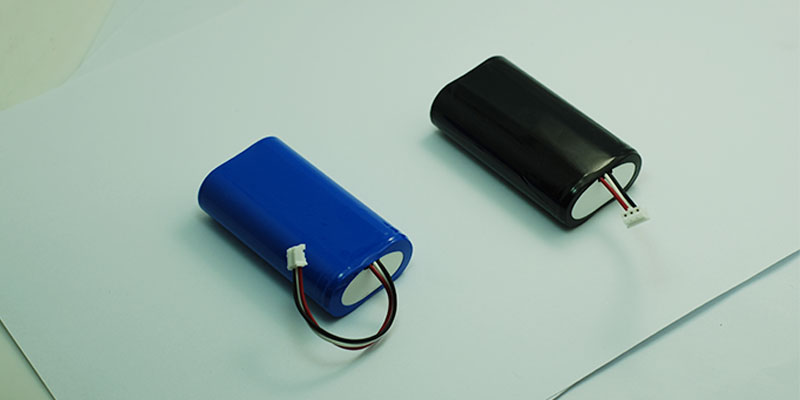
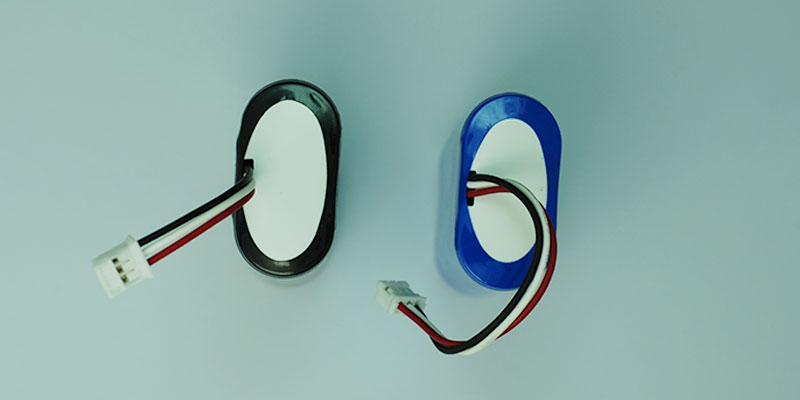
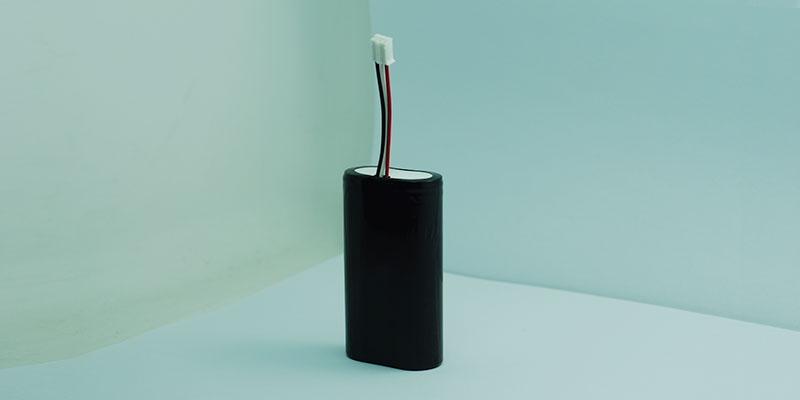
  • In today’s fast-paced and technologically driven world, custom lithium battery solutions have become essential for meeting the specific needs of various industries. From electric vehicles to renewable energy storage, different sectors have unique requirements that off-the-shelf batteries may not adequately address. Customized battery solutions allow businesses to optimize performance, enhance reliability, and meet the specific demands of their applications.
  • Industries such as automotive, energy storage, medical devices, and industrial machinery all require tailored energy solutions to operate effectively. Each application has its own unique power needs, form factor considerations, and operational challenges. Custom lithium batteries provide the flexibility needed to meet these demands, ensuring that systems run smoothly and efficiently.

Bulk_lithium_battery_orders_

  1. Advantages of Custom Lithium Batteries
  • Tailored Battery Features for Specific Applications: Custom lithium batteries can be designed with specific characteristics to meet the needs of a particular application. Whether it’s adjusting capacity, voltage, size, or discharge rate, custom batteries are engineered to align with the exact requirements of the device or system they will power. This level of customization ensures optimal performance and efficiency, providing a significant advantage over generic battery solutions.
  • Enhanced Performance, Efficiency, and Reliability: Custom lithium battery solutions improve overall performance by optimizing battery chemistry, design, and configuration. For instance, batteries used in high-power applications such as electric vehicles may require a focus on energy density and rapid discharge, while batteries for solar storage systems might prioritize longevity and steady discharge rates. Tailoring these parameters to suit specific needs enhances reliability and operational efficiency, reducing downtime and maintenance costs.
  • Flexibility in Design and Size: One of the key benefits of custom lithium batteries is the flexibility in design and form factor. Batteries can be manufactured to fit into unconventional spaces or meet size constraints that standard batteries cannot accommodate. This flexibility is particularly beneficial in applications where space is limited, such as portable medical devices or compact industrial machinery. Custom batteries ensure that the available space is utilized effectively, enabling better integration and improved functionality.
  1. Common Customization Scenarios
  • Electric Vehicles (EVs) and Power Tools: The automotive industry and power tool manufacturers often require specialized battery solutions that can deliver high power output and withstand demanding conditions. Custom lithium batteries for EVs are designed to provide long-range capabilities, high energy density, and rapid charging, ensuring that vehicles perform at their best. Similarly, power tools require batteries that offer consistent power, quick recharge times, and durability to handle heavy-duty use.
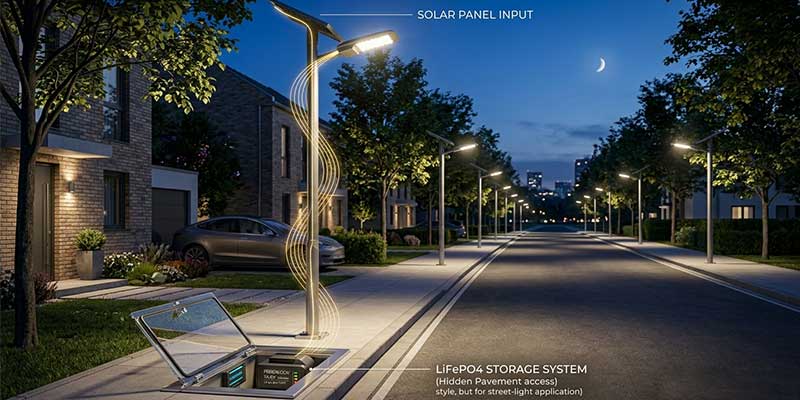
  • Home Energy Storage and Renewable Energy Systems: Custom lithium batteries are widely used in home energy storage and renewable energy systems, such as solar power installations. These batteries are tailored to store excess energy generated by solar panels during the day, making it available for use at night or during periods of low sunlight. Customization allows for the optimization of battery capacity, charge cycles, and efficiency, ensuring that homeowners can maximize the benefits of their renewable energy investments.
  • Industrial Equipment and Medical Devices: Industrial equipment often requires reliable power sources that can withstand harsh operating conditions, such as extreme temperatures, vibrations, and heavy loads. Custom lithium batteries are designed to meet these requirements, providing consistent power and resilience. In the medical field, custom batteries are critical for powering life-saving equipment like portable ventilators and diagnostic tools. These batteries must be highly reliable, safe, and capable of delivering consistent performance, making customization an essential aspect of their design.
  1. Key Considerations for Bulk Custom Orders
  • Determining Battery Specifications Based on Requirements: When placing a bulk custom order for lithium batteries, it is crucial to determine the specific characteristics required for the intended application. Factors such as capacity, voltage, form factor, and discharge rate should be carefully evaluated to ensure that the battery meets the needs of the device or system. Engaging with experts to determine these specifications can help avoid issues related to underperformance or incompatibility.
  • Ensuring Compliance with Safety and Certification Standards: Safety is a top priority when dealing with lithium batteries, especially for bulk orders. It is essential to work with suppliers who adhere to industry safety standards and have the necessary certifications, such as UL, CE, and RoHS. These certifications ensure that the batteries have been tested for safety and reliability, reducing the risk of accidents or malfunctions. Communicating with the supplier to confirm compliance with these standards is an important step in the procurement process.
  • Delivery Timelines and Production Capacity: Another critical consideration for bulk custom orders is the supplier’s ability to meet production demands and deliver on time. Understanding the supplier’s production capacity and lead times helps in planning inventory and ensuring that projects are not delayed due to supply chain issues. Clear communication with the supplier about delivery expectations and potential contingencies can help avoid disruptions in the supply chain.
  1. Key Factors for Choosing a Custom Lithium Battery Supplier
  • Supplier’s Technical Capabilities and Industry Experience: The technical capabilities and industry experience of a supplier are crucial factors when selecting a partner for custom lithium battery solutions. A supplier with extensive experience in designing and manufacturing custom batteries will be better equipped to understand the unique requirements of different industries and provide tailored solutions that meet those needs. Evaluating the supplier’s past projects, expertise in battery chemistry, and engineering capabilities can help in making an informed decision.
  • High Level of Customer Support and After-Sales Service: Custom battery solutions often require ongoing support to ensure proper integration and operation. A supplier that offers high-quality customer support, including technical assistance, troubleshooting, and after-sales service, can make a significant difference in the success of a project. Reliable after-sales support ensures that any issues are addressed promptly, minimizing downtime and maintaining the performance of the battery system.
  1. Introduction to Himax Electronics
  • Himax Electronicsis a leader in providing custom lithium battery solutions, offering expertise in designing and manufacturing batteries tailored to meet the unique needs of various industries. With a focus on quality, innovation, and customer satisfaction, Himax Electronics has established itself as a trusted partner for businesses looking for customized energy storage solutions.
  • Himax offers a wide range of custom lithium battery packs that are designed to meet the specific requirements of applications such as electric vehicles, renewable energy systems, industrial machinery, and medical devices. Their team of engineers works closely with clients to understand their needs and deliver solutions that optimize performance, efficiency, and reliability. Himax’s commitment to quality ensures that every battery is manufactured to the highest standards, providing clients with the confidence they need in their energy storage systems.
  • In addition to high-quality products, Himax Electronics is dedicated to providing exceptional customer support and technical assistance throughout the entire process, from design and prototyping to production and after-sales service. By choosing Himax as a supplier, businesses can benefit from tailored solutions, competitive pricing, and a commitment to helping clients achieve their energy storage goals.

Custom_battery_solutions_

  1. Conclusion
  • Custom lithium battery solutions are essential for businesses looking to gain a competitive advantage in their respective industries. By tailoring battery characteristics to meet specific application needs, companies can improve performance, enhance reliability, and ensure optimal integration into their systems. The flexibility offered by custom battery solutions makes them ideal for a wide range of applications, from electric vehicles to medical devices and renewable energy storage.
  • Choosing the right supplier is a critical factor in the success of any custom battery project. By partnering with a reputable supplier like Himax Electronics, businesses can ensure access to high-quality products, expert guidance, and reliable customer support. Himax’s expertise in custom lithium battery solutions makes them an ideal partner for companies looking to meet their bulk energy storage needs and achieve long-term success in their industry.